
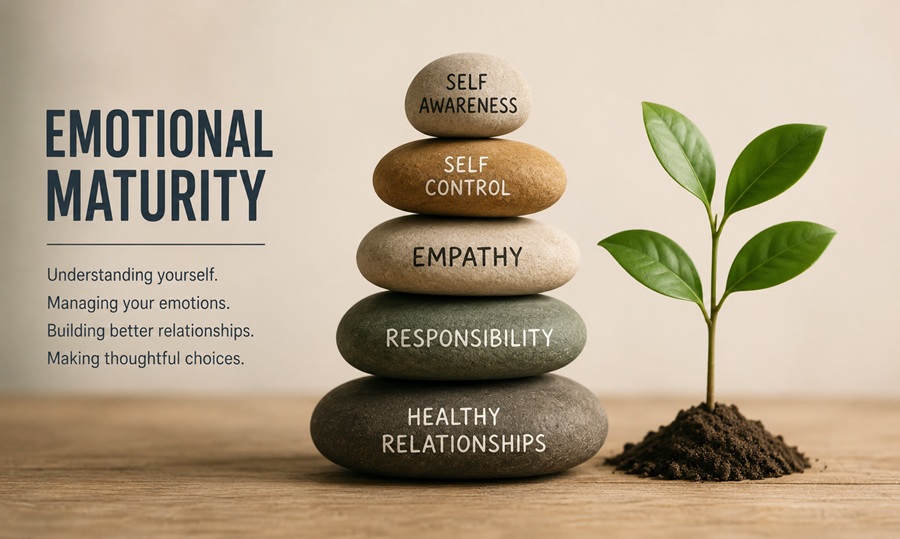
Emotional maturity is the ability to recognize, manage, and express your emotions in a way that doesn’t harm yourself or the people around you. It shows up as staying calm during conflict, taking responsibility for mistakes without spiraling into shame or blame, and being able to consider someone else’s perspective even when you’re upset. It’s not about never feeling angry or hurt, it’s about how you handle those feelings once they show up.
What Is Emotional Maturity, Exactly?
Emotional maturity is a set of learned skills rather than a fixed personality trait. It includes self-awareness, the ability to notice what you’re feeling and why, self-regulation, the ability to respond rather than react, and empathy, the ability to hold someone else’s feelings alongside your own. Unlike emotional intelligence, which focuses more on understanding emotions broadly, emotional maturity is specifically about how consistently you apply that understanding under pressure.
What Are the Signs of Emotional Maturity?
- Taking responsibility for mistakes instead of deflecting blame
- Staying reasonably calm during disagreements, even heated ones
- Apologizing directly, without excessive justification or over-apologizing
- Listening to understand, not just to respond
- Setting boundaries without guilt or hostility
- Tolerating discomfort, disappointment, or delayed gratification without lashing out
- Reflecting on patterns instead of repeating the same conflicts
Why Does Emotional Maturity Matter in Relationships?
Relationships inevitably involve friction, different needs, different communication styles, occasional hurt feelings. Emotional maturity determines whether that friction becomes a solvable problem or a repeated wound. Partners with strong emotional maturity can disagree without escalating into contempt, and they can hear criticism without treating it as a personal attack. Over time, this builds a level of safety that lets both people be honest instead of walking on eggshells.
Real-World Examples: Mature vs. Immature Responses
Example 1: Being Criticized
Immature response: getting defensive, listing the other person’s flaws in return, or shutting down completely. Mature response: pausing, asking a clarifying question, and considering whether the feedback has merit before responding.
Example 2: A Canceled Plan
Immature response: guilt-tripping the other person or giving them silent treatment. Mature response: expressing disappointment honestly, then accepting the explanation and moving forward without holding a grudge.
Example 3: A Disagreement About Money
Immature response: bringing up unrelated past grievances to win the argument. Mature response: staying focused on the actual issue and working toward a compromise both people can accept.
How Can You Become More Emotionally Mature?
Emotional maturity develops through practice, not insight alone. Start by naming your emotions specifically, frustrated, embarrassed, disappointed, rather than defaulting to a vague “fine” or “bad.” Practice pausing before reacting, even a count of five seconds can prevent an impulsive response you’ll regret. And when you do overreact, which everyone does occasionally, own it directly instead of minimizing it. Consistent small corrections build the skill over time far more effectively than trying to overhaul your reactions all at once.
What Does an Emotionally Immature Partner Look Like?
An emotionally immature partner tends to avoid accountability, treats every disagreement as a threat, and struggles to sit with someone else’s negative emotions without either fixing, dismissing, or escalating them. This doesn’t mean the relationship is doomed, emotional maturity can be built, but it does mean patterns need to be named clearly rather than excused indefinitely.
Can You Grow Emotionally Without Therapy?
Therapy accelerates the process, especially for patterns rooted in childhood experiences, but it isn’t the only path. Journaling after emotionally charged moments, asking a trusted friend for honest feedback about your reactions, and deliberately practicing calm responses in low-stakes situations, a rude driver, a minor inconvenience at work, all build the same underlying skill. The key is consistency over time rather than a single breakthrough moment.
How Do You Handle a Partner Who Isn’t Emotionally Mature Yet?
Growth is possible, but it requires the other person’s willingness to engage with feedback rather than dismiss it. Name specific patterns calmly, “when I bring up a concern, I notice you shut down instead of responding”, rather than labeling the person’s character. If the pattern persists despite direct, repeated conversations, it’s worth considering whether the relationship can meet your needs as it currently stands, since one partner’s growth alone can’t sustain a relationship indefinitely.
How Does Emotional Maturity Show Up Outside of Relationships?
Emotional maturity isn’t limited to romantic partnerships. It shows up at work when receiving critical feedback without becoming defensive, in friendships when handling disagreement without cutting people off, and in everyday frustrations, traffic, long lines, unexpected setbacks, without letting a bad moment spiral into a bad day. Because it’s a general skill rather than a relationship-specific one, building it in one area of life, work, family, friendships, tends to carry over into how you handle romantic relationships too.
Small Daily Practices That Build Emotional Maturity
- Pause for a few seconds before responding when you feel a strong emotional reaction
- Name the specific emotion you’re feeling instead of a vague label like fine or upset
- Ask yourself what need is underneath the reaction, feeling ignored, disrespected, overwhelmed
- Apologize directly when you overreact, without over-explaining or minimizing it
- Check in with how someone else might be experiencing a situation before reacting to your own version of it
Frequently Asked Questions
Can emotional maturity be learned as an adult?
Yes. While early environment shapes emotional habits, adults can build emotional maturity through consistent practice, therapy, and honest self-reflection at any age.
What’s the difference between emotional maturity and emotional intelligence?
Emotional intelligence is the broader ability to recognize and understand emotions in yourself and others. Emotional maturity is how consistently you apply that understanding, especially under stress.
Is emotional maturity related to age?
Not directly. While life experience can build emotional skills, plenty of older adults remain emotionally reactive, while some younger people show strong emotional regulation earlier in life.
How can you tell if you’re emotionally immature yourself?
Common signs include frequent defensiveness, difficulty apologizing sincerely, and a pattern of blaming circumstances or other people for your own reactions. Honest self-reflection, or feedback from someone you trust, is usually the fastest way to spot these patterns.