
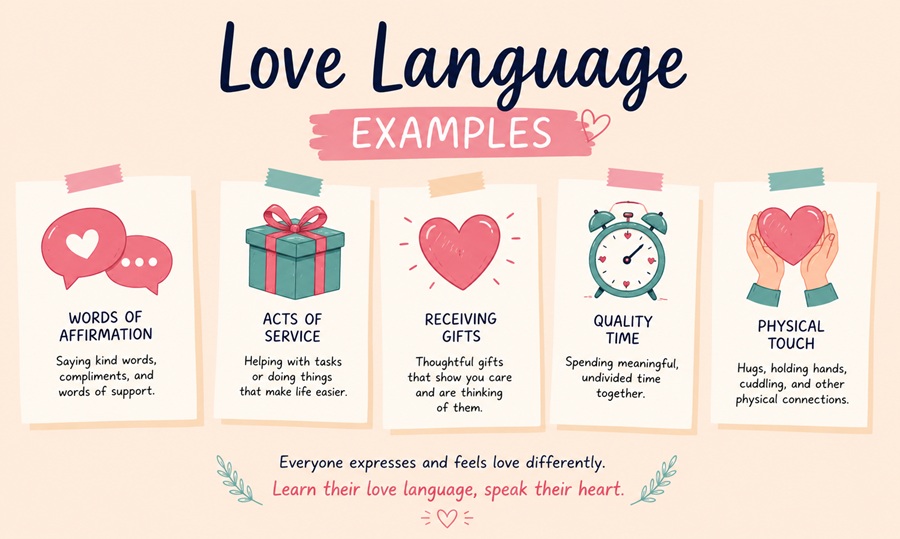
The five love languages — words of affirmation, acts of service, receiving gifts, quality time, and physical touch — describe the ways people prefer to give and receive love. Recognizing your partner’s language, and using it deliberately, often closes gaps that pure effort alone doesn’t.
A couple I know spent years frustrated with each other over something neither could quite name. She kept cooking elaborate dinners and cleaning the kitchen before he got home; he kept telling her how pretty she looked and how proud he was of her. Both were pouring love into the relationship constantly — and both felt like it wasn’t landing. It wasn’t until they came across the concept of love languages that the disconnect finally made sense: she was speaking acts of service, and he was speaking words of affirmation, and neither one felt “loved” in the language they actually needed.
The Five Love Languages, Compared
| Love Language | What It Looks Like | Example in Practice |
| Words of Affirmation | Verbal appreciation, encouragement, compliments | “I’m really proud of how you handled that today” |
| Acts of Service | Doing helpful things without being asked | Filling their car with gas before a long drive |
| Receiving Gifts | Thoughtful tokens that show you were thinking of them | Bringing home their favorite snack for no reason |
| Quality Time | Undivided, present attention | A phone-free walk with real conversation |
| Physical Touch | Non-sexual affection that signals closeness | A hand on the back while passing in the kitchen |
Words of Affirmation in Action
For someone whose primary language is words of affirmation, hearing “I appreciate you” or “you did a great job with that” carries more weight than a gift or a favor. Criticism, sarcasm, or silence lands especially hard with this group, since words are exactly the currency they’re listening for.
This doesn’t mean constant compliments — generic or excessive praise can start to feel hollow. What tends to land is specific, timely acknowledgment: naming exactly what someone did well and why it mattered, rather than a vague “good job” tossed out reflexively.
Acts of Service in Action
This language is about actions that reduce a partner’s mental or physical load — doing the dishes without being asked, picking up their dry cleaning, or handling an errand they’ve been dreading. The key detail is that it has to be freely offered, not extracted through nagging, or it loses its emotional impact.
People who speak this language fluently tend to notice what needs doing before being asked — which is exactly why it can feel invisible to a partner who doesn’t share the language. Naming the effort out loud (“I noticed you handled the whole grocery run, thank you”) helps close that gap even if it’s not your own primary language.
Receiving Gifts in Action
This isn’t about materialism — it’s about the thought behind the object. A five-dollar item that shows a partner was paying attention (remembering a favorite candy, a book they mentioned once) often lands harder than an expensive but generic gift.
For this group, the absence of a gift on a meaningful occasion can sting more than it would for others, not because of the object itself but because of what its absence seems to signal about attention and thoughtfulness.
Quality Time in Action
For this group, presence is the point. A dinner where both people are on their phones doesn’t count, even if it technically happened together. What registers is undivided attention — a conversation with real eye contact, a shared activity with no distractions.
Quantity matters less than quality here — a focused, uninterrupted twenty minutes often means more to this group than an entire evening spent physically together but mentally elsewhere.
Physical Touch in Action
This can be as simple as holding hands during a movie, a hug after a hard day, or sitting close on the couch. For people with this primary language, physical distance during conflict can feel more distressing than the disagreement itself.
It’s worth noting this language isn’t inherently sexual — much of it is casual, everyday affection: a hand on the shoulder, sitting close on the couch, a hug that lasts a beat longer than usual.
Love Languages and Conflict
Love languages aren’t just useful during peaceful times — they can also shape how repair happens after a disagreement. A partner whose primary language is words of affirmation may need to hear an explicit apology to feel resolution, while a partner whose language is acts of service might feel more repaired by a partner quietly taking care of something that had been a point of tension, rather than through words alone. Recognizing this can help couples repair more effectively after conflict, rather than assuming a single universal way to make amends.
A useful shortcut: notice what you complain about most, and what you naturally give to others. People often express love the way they most want to receive it — so if you’re constantly doing favors for your partner and feeling under-appreciated, acts of service may be your language too.
When Partners Have Mismatched Languages
Mismatched love languages don’t doom a relationship — they just require translation. The couple in the opening example didn’t need to change who they were; they needed to consciously add a few sentences of verbal appreciation and a few acts of service into their existing habits, aimed specifically at the language the other person was actually listening for.
Love Languages in Different Relationship Contexts
Love languages aren’t limited to romantic partnerships. Parents can apply the same framework with children, noticing whether a kid responds more to verbal praise, physical affection, or quality time — and friendships often run on an unspoken love language too, which is part of why some friends default to gift-giving and others default to long phone calls as their way of showing they care.
Love Languages at Work and in Friendship
A coworker who always remembers small details about your life may be expressing acts of service or words of affirmation in a professional context, while a friend who never misses a birthday gift may simply be speaking the language they’d want to receive themselves. Recognizing this outside of romance can make it easier to appreciate gestures that might otherwise go unnoticed.
Common Mistakes When Applying Love Languages
- Assuming your partner’s language matches your own, rather than asking directly
- Using the framework as an excuse (“that’s just not my language”) to avoid effort altogether
- Focusing only on your primary language and ignoring your partner’s secondary one
- Treating a single grand gesture as a substitute for consistent, smaller expressions
A Simple Weekly Practice
Couples looking to put this into action can try a simple weekly habit: each partner picks one small, deliberate act in the other’s primary love language, done without being asked. Over a few months, this compounds — not because the individual gestures are dramatic, but because consistency in the right language builds a felt sense of being understood that occasional grand gestures rarely match.
Frequently Asked Questions
Can someone have more than one primary love language: Yes — many people have a clear top language with a strong secondary one, rather than exactly one.
Do love languages change over time: They can shift with life stages; a new parent, for example, may temporarily value acts of service more than usual.
Is the love languages concept scientifically proven: It’s more a popular framework than a rigorously tested theory, though many couples find it useful as a communication tool.
What if my partner and I have the same love language: That can make things easier, since you’re both naturally speaking a language the other understands.
How do I ask my partner about their love language without it feeling weird: Frame it as curiosity: “What’s something small I do that makes you feel most loved?” often opens the conversation naturally.
Do love languages apply outside of romantic relationships: Yes — the same framework can describe how friends, family members, and even coworkers naturally express and prefer to receive appreciation.
Is it a bad sign if my partner doesn’t naturally speak my love language: No — most people default to expressing love the way they’d want to receive it, so a mismatch is common and simply requires open communication, not concern.
Understanding love languages isn’t about turning affection into a formula — it’s about making sure the love you’re already giving actually gets received the way you intend it.