
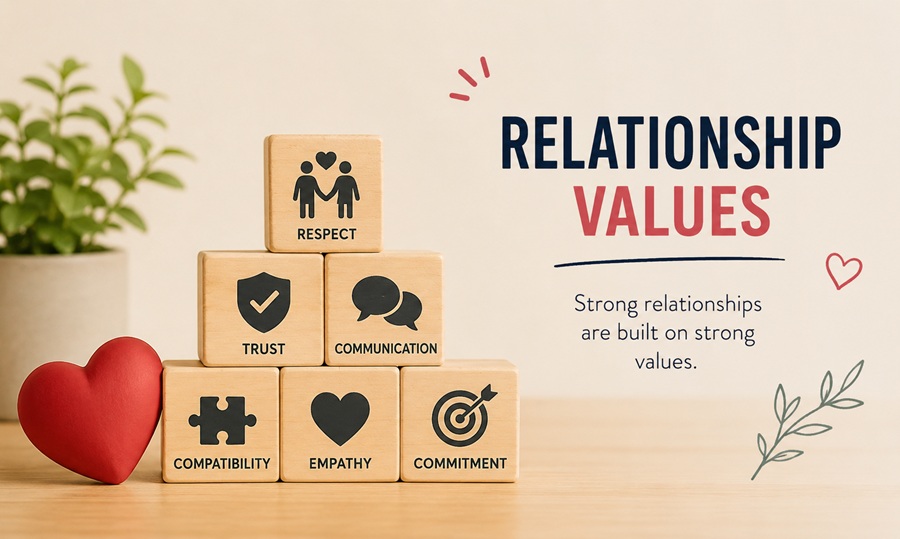
Relationship values are the core beliefs and priorities that guide how a couple approaches major life decisions, honesty, family, money, ambition, faith, and how conflict should be handled. Two people can have great chemistry and still struggle long-term if their values don’t align, because values determine how big decisions get made once the initial excitement settles.
A Case Example: Two Couples, Two Outcomes
Consider two couples who met around the same time. The first couple had strong chemistry but different values around money, one prioritized saving and security, the other prioritized spending on experiences. Early on, this felt like a minor quirk. Over several years, it became a recurring source of tension every time a financial decision came up, because the disagreement wasn’t really about money, it was about two different visions of what a good life looks like.
The second couple had less immediate chemistry but shared clear alignment on core priorities, both wanted the same approach to raising children, similar views on how much time to spend with extended family, and matching attitudes toward career ambition. Their relationship required less negotiation over major decisions because they were already pointed in the same direction. Chemistry grew over time as trust built, while the first couple’s chemistry slowly eroded under the weight of constant negotiation.
Lessons Learned From Each Scenario
The first couple’s story shows that chemistry can mask a values gap early on, but it rarely closes that gap on its own. The second couple’s story shows that values alignment creates a kind of relationship stability that makes room for chemistry and connection to deepen over time, rather than being drained by constant disagreement over fundamentals.
What Counts as a Core Relationship Value?
- Approach to money: saving vs. spending, financial risk tolerance
- Views on family: how involved extended family should be, parenting philosophy
- Career ambition: how much priority work should hold relative to personal life
- Honesty and conflict style: direct communication vs. conflict avoidance
- Faith or spirituality: shared beliefs or mutual respect for differences
- Lifestyle preferences: how social vs. private, urban vs. rural, adventurous vs. routine-oriented
How Do You Know If Your Values Align With Your Partner’s?
Values alignment shows up in how decisions get made, not just what someone says they believe. Pay attention to how your partner actually handles a financial decision, a family obligation, or a career opportunity, not just how they describe their values in conversation. Misalignment tends to surface in recurring arguments that seem to be about the same underlying issue, even when the specific topic changes each time.
Recommendations: How to Have the Values Conversation
Bring up values directly rather than assuming they’ll reveal themselves naturally. Ask specific, concrete questions: how do you imagine handling finances together, how much contact with extended family feels right to you, what does a fulfilling career look like to you. Have this conversation earlier rather than later, ideally before major shared commitments like moving in together, marriage, or having children, since misalignment becomes much harder to renegotiate once those decisions are already made.
Can Two People With Different Values Still Build a Good Relationship?
Sometimes, if the differences fall in areas both people are genuinely willing to flex on, and if the disagreement doesn’t touch something either person considers non-negotiable. The distinction matters: a preference, wanting to travel more versus save more aggressively, can usually be compromised on. A core value, wanting children versus not wanting them, generally can’t be split down the middle without one person feeling like they gave up something essential.
How Do Values Shift Over Time?
Values aren’t static. Career ambitions can mellow, financial priorities can shift after a major life event, and views on family can change with time or experience. This is normal, but it means the values conversation isn’t a one-time checklist, it’s worth revisiting periodically, especially around major transitions like a new job, a move, or the decision to have children.
What Happens When Values Are Discovered Too Late?
Some couples don’t uncover a major values gap until well into the relationship, sometimes after moving in together or getting engaged. When this happens, it’s worth having the direct conversation rather than avoiding it out of fear of conflict. In some cases, couples find a workable compromise once the issue is finally named openly. In others, the honest conversation reveals that the relationship can’t accommodate both people’s core needs, which is painful, but far better to learn before a deeper commitment like marriage or children than after.
Frequently Asked Questions
What’s the difference between relationship values and compatibility?
Compatibility often refers to shared interests and personality fit, while relationship values refer to deeper priorities around money, family, and life direction that shape long-term decision-making.
Can a relationship work if values don’t fully align?
Yes, if the differences are in lower-priority areas and both people are willing to compromise. It becomes more difficult when the misalignment touches core priorities like having children or financial philosophy.
When should couples talk about their values?
Ideally early in a relationship, and again before major commitments like moving in together, marriage, or starting a family, since values can shift as a relationship becomes more serious.
Do relationship values change over time?
Yes, life events like career changes, having children, or financial setbacks can shift priorities, which is why revisiting the conversation periodically matters, not just having it once.